The Problem
Customer reported intermittent hesitation on cold mornings over two weeks - car would surge once then drive normally. Fault became permanent after a cold overnight: vehicle entered Ready state, dash showed no warnings, accelerator pedal input registered in live data, but car would not move from a standstill. Towed in. Scan: P0C73 (Electric Motor Position Sensor A - Performance) and P0C76 (Electric Motor Position Sensor A - Circuit Intermittent). No collision, no water exposure, last service was a brake fluid change three months prior.
Diagnostic Procedure
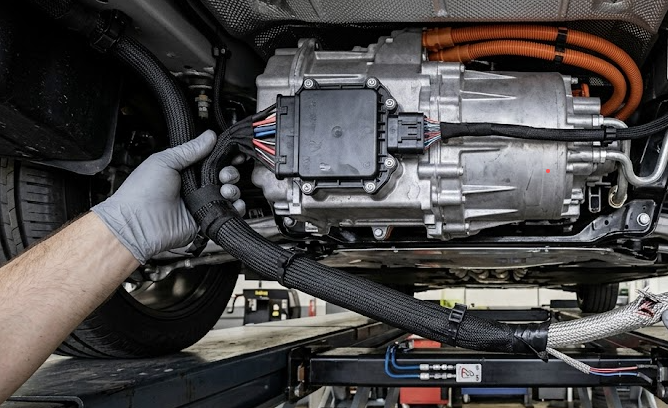
-
1
1. Confirm P0C73 and P0C76 with BMW-capable scan tool (ISTA or Autel with BMW pack). Pull live data - check resolver signal amplitude and frequency on both sin and cos channels.
-
2
2. Note fault history pattern: intermittent then permanent, worse in cold conditions - this points to a mechanical/connection issue in the resolver circuit, not an ECU or motor fault.
-
3
3. Locate the resolver harness routing from the electric drive unit to the power electronics module. On i4 eDrive40, the harness runs along the left side of the rear subframe before entering the cabin connector.
-
4
4. Inspect the full harness run under load simulation - flex the harness at multiple points while monitoring live resolver data. Look for signal dropout or amplitude drop on either channel.
-
5
5. Pay special attention to any points where the harness passes over or around metal edges, mounting brackets, or areas exposed to heat cycling from the drive unit.
-
6
6. In this case: flexing the harness approximately 180mm from the drive unit connector caused immediate signal loss on the sin channel. Outer sheath intact - the fault was internal.
-
7
7. Cut open the outer sheath at the identified flex point. Inspect the shield braid and individual conductors under magnification. Check for broken shield strands, cracked conductor insulation, or chafed signal wires.
-
8
8. Perform continuity and insulation resistance test on the affected segment before and after repair.
Resolution & Root Cause
Shield braid on the resolver harness had a circumferential crack at a tight bend radius approximately 180mm from the drive unit connector - likely from thermal cycling over the first 40,000 km of operation. One signal conductor (sin+) had a hairline crack in the copper stranding at the same location, causing high resistance under cold conditions and open circuit when the crack fully propagated. Harness repaired using butt splice connectors with adhesive-lined heat shrink on affected conductors, shield continuity restored, outer sheath sealed with self-amalgamating tape. Resolver signal live data confirmed: sin and cos channels nominal amplitude, no dropout under flex. P0C73 and P0C76 cleared, did not return on 500km follow-up. Total: 3h diagnostic + repair labor.
💡 Key Lesson
P0C73 on BMW i4 with no propulsion does not mean motor or power electronics failure. The resolver is a precision analog sensor - its signal is carried over a shielded harness that is sensitive to flex fatigue. Cold-worse intermittent faults that become permanent almost always have a mechanical root cause in the wiring. Always flex-test the full resolver harness under live data monitoring before quoting any drivetrain component. This case saved approximately 8,000 USD in unnecessary drive unit authorization.
About This Case
This case was solved remotely by an HVDesk specialist with 15+ years of hands-on experience across major EV platforms including Tesla, Hyundai/Kia, Volkswagen ID series, BMW i-series, and Ford EVs. The procedure was provided as structured remote support to an independent auto repair shop.